Stevenage holds a special place for town planners, as the first designated New Town in the post-war housing stock recovery period.
As Europe pays respect to the fallen 80 years after D Day, we look at what happened afterwards from a town planning perspective.
Read Liz’s fascinating blog about those early-post war years, bringing the housing need issue up to date in light of the upcoming election and manifesto promises.
The Post-War Housing Restock
D-Day 1944 has been referred to as the beginning of the end of World War II. By the end of 1945 war was over and England was left with the legacy of years of bombings, rationing and grief.
Many had evacuated the cities and were left homeless or living in haphazard accommodation and there was a dire shortage of houses to accommodate those in need.
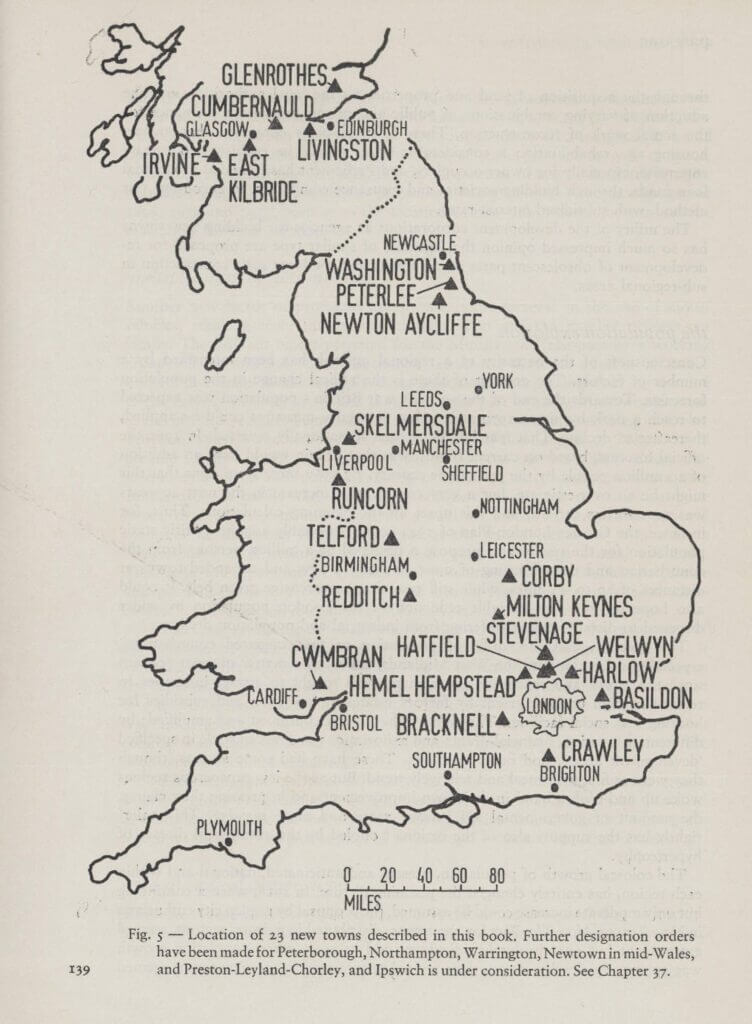
In the post-war era New Towns became a phenomenon. Primarily located in a ring around London beyond the Green Belt, these planned settlements were intended to address the severe housing shortage.
Enacted in August 1946 the New Towns Act made way for New Town Development Corporations. The Development Corporations were responsible for the management, design and development of New Towns. The boards were appointed by central Government and publicly financed with planning and compulsory purchase order powers.
The movement brought about the construction of 28 New Towns between circa 1946-73, following several iterations of the New Towns Act. Stevenage was the first to be designated in 1946.
The New Town movement stalled in the mid-70s following criticisms of poor quality housing and a lack of decent transportation links. At this time development became reliant on the Local Plan process and site allocations brought forward by individual Local Planning Authorities.
There have been many attempts since the 1970s to boost housing delivery. For instance, we saw the creation of Regional Assemblies under the Regional Development Agencies Act 1998, designed to work across the region on the economic, social and environmental policy agenda, with the creation of Regional Spatial Strategies (remember them?). These essentially replaced County Council Structure Plans.
House Building Progress This Century
In 2007, Gordon Brown pledged to designate 10 new “eco-towns” of at least 5,000 homes. Only one site was identified, which was the already planned and just now being realised Northstowe development in Cambridgeshire.
Following the General Election in 2010, the Coalition Government withdrew all funding and statutory functions from Regional Assemblies and replaced them with Local Enterprise Partnerships (LEP).
The LEPs were largely voluntary and unfunded with local growth deals being sought for projects that benefited the local area and economy. However, all Government funding for the LEPs will be withdrawn this year.
In 2016, the Conservative Government published the locally led Garden Villages, Towns and Cities Prospectus, calling for expressions of interest for new ‘Garden Villages’ of between 1,500 to 10,000 homes. Later stages would consider expressions of interest for new garden towns and villages of 10,000 homes+.
Alongside larger Garden Towns, such as ‘Harlow and Gilston’, in January 2017 the Government lent their support to 14 planned Garden Villages, proposed to facilitate some 48,000 new homes.
Many are now progressing, but due to their scale the realisation of the quantum of development will not be seen for many years.
The Real Cost of Failure
The upshot of these varying attempts is a continuing lack of housing delivery across England.
As a result, we’re seeing a shortage of housing and a rising cost of housing, with home ownership being out of reach for most young people and private rents increasing at record rates.
The Homes for All report: Homes for All: A Vision for England’s Housing System (April 2024) identifies:
- A shortfall of 657,000 new homes against the national targets for the last 5 years
- 1.2million households on Local Authority social housing waiting lists
- A minimum of 271,000 people recorded as homeless on any given night in 2022
- 131,000 children in temporary accommodation in 2023.
The social impact of the housing shortage cannot be underplayed.
And Now?
The recent changes in the NPPF have already seen Local Authorities seeking to reduce their housing delivery within their emerging Local Plans.
For some this is based on there being a need to review their Green Belt boundaries if they were to meet the full housing need for their areas. For others, to simply provide the minimum delivery and not assist neighbouring Authorities.
While this currently only applies to 15 Local Authorities, it equates to a shortfall of 13,630 dwellings per annum.
This appears to be a growing trend and if more were to apply the same principles, England would stand no chance of ever delivering sufficient housing to address the identified shortfall or reduce the affordable housing waiting lists.
It’s not surprising then that with the General Election looming the need to deliver housing, especially affordable housing, is a key manifesto matter for all the parties.
Election Promises
At the time of writing both the Liberal Democrats and Conservative manifestos have been published, so there remains speculation around the detail of the Labour policies.
The Liberal Democrats are focusing on the expansion of Neighbourhood Planning, the delivery of ten new Garden Cities and encouraging rural exception sites to expand rural housing.
The Conservatives have set a target of building 1.6 million homes over the next five years, delivering a record number of homes on brownfield land, unblocking 100,000 homes through the removal of EU policies and providing a fast-track route through the planning system for homes on previously developed land in the 20 largest cities.
It’s worth noting that around 220,000 dwellings were completed in the UK in 2023, so an average of 320,000 dwellings would be a significant stretch target based on current performance.
So far, the Labour party have announced their intent to deliver New Towns again and set up a New Town Commission within six months of the General Election. They are planning to build 1.5 million homes over the first five years, with 40% affordable housing delivery. They are also looking to assess the Green Belt, to identify what is considered to be ‘grey belt’ and therefore suitable for development opportunities.
This Planner’s Perspective
From a planner’s perspective, if we want to resolve the housing crisis we cannot continue with more of the same. The problem is getting worse, not better!
It’s likely that a multi-pronged attack is going to be required to enable housing to come forward in the short/medium term. This will allow the longer term prospects such as New Towns and Garden Cities to come to fruition – especially if they are to benefit from appropriate and meaningful infrastructure.
We wait with bated breath to see how the debate unfolds and what 4 July brings!