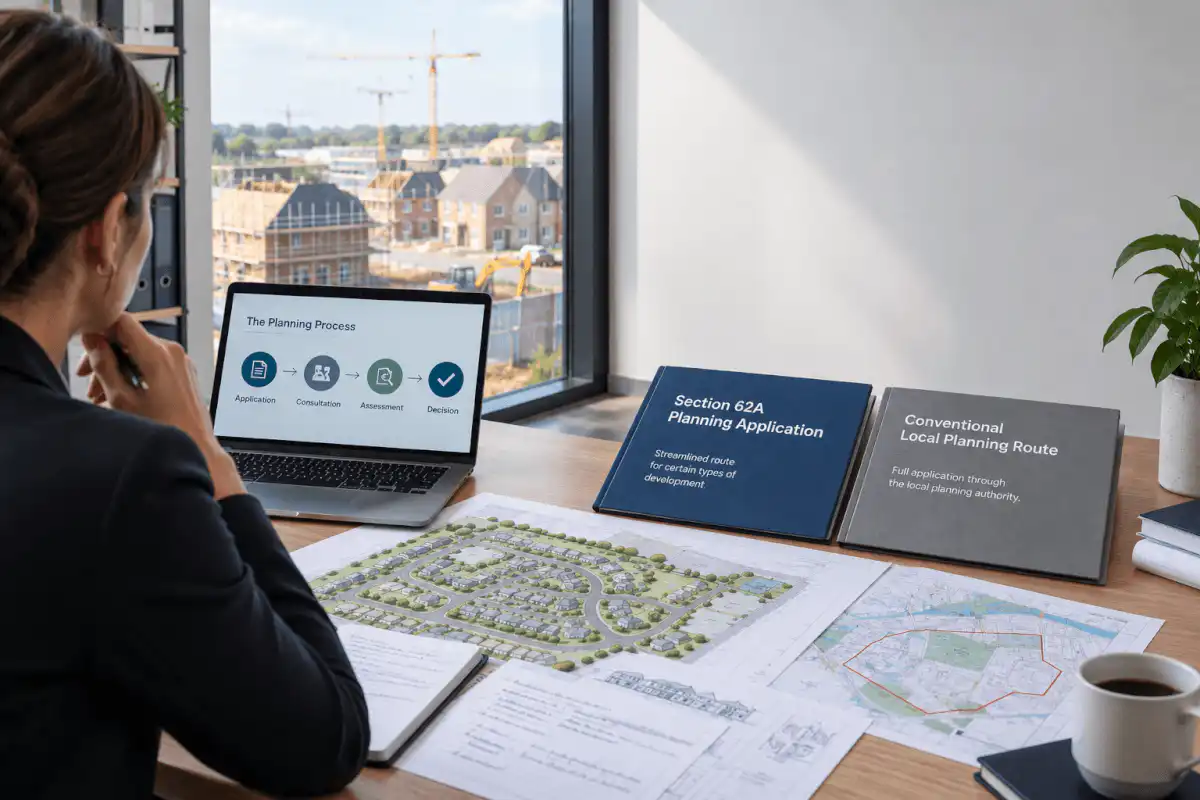
Section 62A of the Town and Country Planning Act allows certain planning applications, consents and orders to be submitted directly to the Planning Inspectorate (PINS), acting on behalf of the Secretary of State, where a local planning authority (LPA) has been designated for this purpose.
An LPA can be designated where the Secretary of State considers that it is not adequately performing its functions in determining applications. This is generally based on the speed and quality of decision-making, including where a significant proportion of decisions are overturned at appeal.
Which LPAs are currently designated?
For major applications, the designated LPAs are currently:
- Cherwell District Council
- Dacorum Borough Council
- Epping Forest District Council
- Hertsmere Borough Council
- Lewes District Council
- Malvern Hills District Council
- Rossendale Borough Council
- South Tyneside Council
- Staffordshire Moorlands District Council
- Wychavon District Council
The designation is not permanent, but remains in place until it is formally revoked following an improvement in performance.
Why consider a Section 62A application?
The key attraction is the prescribed timescales for determination.
Once an application has been submitted and validated, there is a 21-day consultation period, during which all consultation responses, including those from the LPA, should be received. Representations submitted after this period may not be taken into account.
Following consultation, PINS determines whether the application will proceed by written representations or a hearing. This also affects the timescale for submitting any finalised legal agreement.
What are the risks?
The principal consideration is that the application is determined as submitted. There is no opportunity to negotiate amendments to the proposal during the application process in the same way there may be with an LPA application.
There is also no conventional right of appeal against a Section 62A decision. A decision can only be challenged by way of Judicial Review, and then only on legal grounds rather than on the planning merits of the case. In exceptional circumstances, the Secretary of State can also recover an application for determination by Planning Ministers.
Pre-application advice can be sought from PINS. However, if an LPA is subsequently de-designated, a Section 62A application cannot be made, even where PINS has already provided pre-application advice.
With designations based on both the speed and quality of decision-making, it will be interesting to see whether more LPAs are brought into special measures in the coming months.
For applicants dealing with a designated LPA, Section 62A provides an alternative route to consider – but it comes with its own opportunities, constraints and risks.
.